
 4.7
4.7
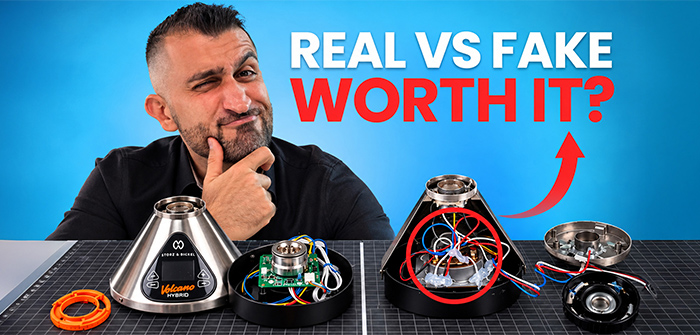

- Transcript of Video:
- Authentic vs Counterfeit Box Comparison
- Authentic vs Counterfeit In-The-Box Comparison
- Exterior Comparison: Authentic vs Counterfeit Volcano Hybrid
- Temperature Testing Between Both Units
- Starting The Counterfeit Volcano Hybrid Teardown
- Internal Function and Component Breakdown
- Internal Material Comparison
- Final Thoughts
Transcript of Video:
I bought a fake volcano so you don't have to. The most expensive vaporizer in the market. Iconic. Started since the beginning. Sometimes outside the sales period getting as high as like 950 bucks after taxes and such. But there's fake ones out there. So, I bought one. We're going to tear it apart. We're going to look inside and see if that can be a good deal. And by the end of the video, you're going to see inside and underneath, and you're going to figure out exactly how it is that they clone it, a little bit about the parts and such. And we're going to get into the functioning.
We're going to get into the components, material safety, and we're going to do some temperature tests, too, because usually getting the temperatures right is one of the more difficult, let's say, tasks. The cool part is that the fake one comes from China, and the real one comes from Germany. So, in the parts, we could be seeing how those little parts differ between what you can get in China and how we can put it together and what you could get in Germany. All right, so let's get into it. I have two boxes
Authentic vs Counterfeit Box Comparison
here. So, this one is authentic. You can see the seal still intact here. This one is the one that I've opened. This is the one that is counterfeit. So, first I'm going to look outside through the box, okay? And show you guys the differences. Uh probably comment on why they're different and then we're going to get into looking at the real one. Um we're going to get inside and we're going to get inside on an authentic unit as well. So, we already have an authentic unit that we use for marketing purposes, but I wanted to show you guys a sealed box because the one that we have is a marketing unit. So, the box is a little that's a beat up.
And right away you can see that while it looks awfully let's say uh similar the content on it is different. So we got the what's in the box over here uh whereas here the what's in the box is like this. Um so and I looked at the early units that we got from the hybrid and this is the latest unit we got from the hybrid. It's it looks like this. So, this is uh kind of a different design, which was a little um let's say interesting to me because this this it says volcano vaporizer. It doesn't say hybrid. And then the text seems to be maybe taken from the manual.
But uh one thing that I can tell you guys right away is that when you look a little bit more in the detail, the tiff symbol here, you can see that this is the right type of file they used. It's very high definition. Whereas here, it looks like it was copied from somewhere and then blown up. So, it's a bit pixelated. So, this is very high quality. This is somehow a bit pixelated, right? So, right away, you can kind of get into the nitty-gritty and some things are different. These people went through the trouble. This is actually extra extra illegal. Uh, they went through the trouble of putting a fake serial number on there.
Now, we're going to compare it to what's inside the unit. I'm going to I'm going to be very interested to see if they have the, let's say, backbone to uh match this one with what's on the unit. One thing that
Authentic vs Counterfeit In-The-Box Comparison
I was actually positive not I can't say it's positive but I was surprised by they actually like this actually looks uh very very close to what the real one is in fact not if not one to one I can see differences so it's not the same didn't come out of the same facility so this is a bit more shiny I can see on the surface this one which is the counterfeit one first of all doesn't have the logos on it and also I must say it kind of looks a little looks a little low quality almost like It's a layer of paint on it. I don't think they need to paint that. They just put the paint in the plastic that they put through the extruder.
This the the color is a little bit more almost like refined and even. It's a bit more pleasing to the eye just a bit. I don't think in terms of function makes much of a difference. Oh, look at that. Yeah, this thing. Look at that. And let's take this off. Oh, look. So, and I've seen Bickl's facility. They have machines to do that, but uh for the volcano, it's like a machine that's also handled by a person. Yeah, it's a little frenzier. So, you can see like on the margins these types of counterfeits come out. So, I'm sure all of you have seen those. I don't know counterfeit. I think I did that one right now. I put the wrong one on.
This is the marketing sample. So, I didn't grab the brand new one. So, don't mind the yellowess. It's actually a couple of years since I think they launched it. Maybe more. actually it's more uh it's a bit basically used for marketing testing and so on and so forth for marketing picture taking video taking the team test these to see what's good. So this one however one clear difference this is the original one um that's ceramic coated. So here the one from the counterfeit and I'll show you other instances of it.
uh they seem to have their facility didn't have the ability to ceramic coat it and we know from our own let's say manufacturing because we have devices that have gold coating uh like the tin 850 the arc was the original one we released it so some people in the industry kind of liked it and they introduced it as well bunch of other products have it too but it matters how you do it because you can't just like right away code it you need like a in between code or something like that you need a special facility for ceramic coating so if you have a regular facility you may not be able to do that. And this this this is very light.
So, it's aluminum. Uh this is also light. So, I I would assume this is ceramic coating on aluminum, not stainless steel. It's very light. All right. Um but in terms of shape, they're the same. This is going to be non-stick. This is going to be extra thick because if it's aluminum, it's very conductive with heat aluminum. So, in some parts, you let's say can't use it. This is this is the part where I start getting a little concerned. This is a plastic part. This is a plastic part in direct touch with stainless steel. So inside is stainless steel, on the outside is this plastic and that thing is going to be in your vapor path.
So I I don't know what plastic they used, but judging by the Germans and I can just by the touch of this. Now again, I can't tell for sure, but it's probably peak probably. Now if it's not peak, it's a uh it's a plastic. They've carefully calibrated perfectly safe in that temperature. I don't know what that is. Right now we are looking at both of them from the top and the stainless steel. This one is a tiny bit more brushed than this one. So, I'm
Exterior Comparison: Authentic vs Counterfeit Volcano Hybrid
pretty sure people would be if they're in person, they can kind of tell. These are the important parts, the heating element parts. The sticker, this is the fake one, has the tube sticker on top. So, they kind of like decided to make the sticker slightly different. I'm not sure why they would do that. Let's see the bottom because the bottom has a serial and we wanted to see if it's the same as on the box. So, clearly this is made for this area and it's a VH7 F6 VH3R. So, this one starts ends with FDA. Let me look on the packaging. Yeah, they match them. They actually did match them.
So, some poor folks that may get these because I don't know, somebody threw it on them. Some unauthorized dealer gave it to them as authentic. One day they're going to end up with Schwarz's warranty breaking the bad news to them. Uh, this cereal doesn't exist. Can we have a look at your unit? So, this is the way it look. It's supposed to look. This is the way it's it this is a counterfeit. This is clearly made in Germany. So this is one of the worst things you can do in manufacturing is put it's like made in a country and then it's not. Um so that's not cool.
This type of screen I've only seen with shorts and like the technology is obviously available in a lot of things and they're very reliable because they're not like the classical LEDs. It's like more like a calculator. So you can see that it's much dimmer than here. And these types of displays are the primary advantage is is uh they're very reliable because an LCD screen or LED screen like you have a lot of pixels on them and each pixel can fail. It's very unlikely that a pixel fails. But obviously if you have like 1080p on that thing you got like I guess 1080 * 920 something like that. You can just do the math.
So these are obviously much more reliable and store thing is hey we're reliable. So now that it's heated there,
Temperature Testing Between Both Units
and I made sure I purposefully waited a bit. So the heater has a lot of mass. So I waited so it gets to that point. And now I'm going to engage the fan. Actually, let me do just one. I'm going to take the tip, put it here. I'm going to use the same tip, which is the authentic tip. I'm just going to put this in there. And this is not necessarily because it's set at a 200 going to show 200 here. Uh because of uh some limitations of this machine. All right. Right. So I'm I I know this is somewhat accurate enough for us to do warranties and such here. Schwz is super accurate with what they do like super accurate.
I they have a lot of test huge testing facility. You can look it up online. Their own YouTube channel and such has footage from there. But what we can do is we can do relative testing. So if we set this up at 200, we know for a fact this is going somewhere between 195 to 205. So it's very accurate. Kind of reaches it's somewhere around 170. So the 200 here by the time the air gots up here where I'm I'm measuring it with this device like 173. So now I have the same temperature set up turned up at the same time. I'm going to put it over here and let's see how far this one goes up.
In theory, if it's like a super awesome clone in terms of temperature performance, all right, we would get around the same temperature, which would be 173. Just climbing up there. Not sure exactly why it's fluctuating this much. Oh wow. Okay. 180. At some point in the engineering world, it's all about tolerances. So if you want to bring the tolerance down, you have to do a lot of engineering. But you can see already this goes all the way up to 180. All right. So you see it's kind of like running away a little bit. So I'm just going to stop this test here. And we can kind of conclude this one runs hotter.
So, I cooled it down just just touching a metal clean metal metal surface transferring the heat out of it. So, we can just have it climb up again. So, there we go. We got a we got a new kind of equilibrium. And you see how accurate it is in terms of it's like one degree up or down. It may not seem like much, but it requires a ton of calibration and work. Now, I'm going to just put it back here again. You guys saw the behavior of the temperature. Let's see, buddy. Come on. So with this one, we went all the way up to like 185 and it would drop down to 170.
So what would happen is um you maybe you're vaporizing at 180, then you want to go to 190. Um but maybe when you were at 180 it's fluctuating higher. When you go to 190, it's fluctuating lower. So your vapor kind of blends into each other. And you can't really like vapor step up because you like 180 and then you like to consume what you get at 190 and then 200. um you can't do that as effectively if the tolerance is too high because then 180 washes with 190 and your vapors become kind of like uh more similar. Now I'm going to get into the device.
Starting The Counterfeit Volcano Hybrid Teardown
Okay, oval versus circular. Um ooh we see already differences in the board that are quite Wow, they're quite obvious. Wow, this board looks much more intricate. This is the central processor. Like that's a nice central processor. like you don't you don't find that in many portable devices. And then you got this this I know from my PlayStation controllers. These are these are really cool ones that I like. I mean I I should tell the engineers because I want to have one in one of our products. Um but uh these are really cool. I think they're super fit. Look, they come through a channel here at the bottom like super tidy.
I guess when I was a kid and I opened my PlayStation controller that was I just became impressionable. But you can see it's it looks a very very complicated board like for the size that it is and the device that is. I actually didn't think Schwarz and Pickle board was going to be this complicated. And then you got this is this is a bit like this is a bit poor. Oh wow. Like there's just nothing here, nothing here. I don't know. Like here's another thing. Like we did one temperature test at 200. I don't know all the ways this thing would fall out of bounds. Look at the ceiling. Oh Oh, that's horrible. The silicone. Oh my god, the silicone.
Oh my god. This is um the silicone is not heat resistant. Okay. I think corking. Yeah. Yeah. This is this is I think corking like what you do with your walls. This is the type of silicone you would I think at least it feels like it you would use in your bathroom. I'm sure this is probably the version for electronics. But I do not think this would be heat resistant. I don't think this is this is okay. I would never have something like that close to a heater. And the heater is right here. And the top side is here. And you can see on the sides here from inside this space there is air that goes in here. So breathing that in.
So it could make it uh make it in and around your vapor. Now given that the central part the the air is coming out here. Um but it's certainly it's it's certainly too close I would say. Look at this. Look at this. this. So you can see the kind of components like I think this is the same as this potentially but they were just one to one copy I would assume with just the local components they have available. This is you just see it's much neater. What is that? That's pretty cool. They have this this thing instead here that this thing is supposed to need to have a clasp like this but they didn't use that. They kind of welded these two together.
Not welded but soldered those two together. One other thing I can notice um here that I can point out to you is uh the tubes here seem to be thicker than the tubes here. Uh so the tubes generally here are a little smaller, a tiny bit smaller than these tubes. So does it matter? Does it not? I don't know. I don't think so. I'm very curious why they bring the air from in here. Wait. So the air comes from here into here and then goes up in here. So, this is the tube that takes the air into the bottom of the heating chamber. I was always under the impression that the top is a heating chamber because the original one had the heater right here.
The intake is on the bottom because they have a hepailter on the bottom. I can show it to you guys. Yes, that's why it's Yeah, that's the fan. Good call. See, Eve is also in. So, here this is the hepoilter. It's not a hepoilter. It's a filter. It's a Okay, it's a little bit nicer quality. Definitely better than that one. I don't want to break it before I By the way, thank you for your comment on what we should do next. It certainly helps me figure out what's popular. And on the last video, I even pinned all of them to the top. I answer the comments on my videos myself. Uh so if you want to talk to me, the comments is the best place.
Like in the first two videos, I literally answered everyone. Okay? I literally answered. I got excited. People want to talk to me. No guarantees I'm going to answer everyone, but I'm going to try to. All right? Got
Internal Function and Component Breakdown
a got a bunch of people. Oh, there we go. Interesting setup. Oh, no. So, they have this kind of let's call it a piston pump or I think that's a piston pump, but um they have this type of pump here. It pushes the air through here that goes comes in through the heater and creates your balloon. Now, the interesting part is that well, we got this the the let's check it out.
uh the way the Germans did it that there's key components that it's like the Chinese are doing differently and usually when that happens is some sort of cost thing but I can already see the plastic on the authentic one it's got like uh a lot of let's say flow marks from the mold you can see here so you see these scratch marks here it's a bit more of a it's not a regular plastic it's not like a regular pretty plastic like ABS and of course you want to make sure your plastics are very well refined because you want to ensure that they are safe as soon as it becomes air pathway thing. So, um the one on the counterfeit is soft.
I can scratch it very easily. This one the scratches show, but it's harder. So, it's definitely a harder plastic. So, these are the things where you always think, okay, what kind of plastics did they use when it's around the air path, right? Check out the boards here, guys. We're going to get the macro lens. And you can kind of judge for yourself which one looks more, let's say, refined and capable. Uh, this one definitely have more mass in these. The plastics are the most important here. And the temperature stability. So, let's go to the heater. Oh, this is not good. Look at that. The screw changed color and it's black.
So some oxidization has happened and this is a brand new unit and you just you just used it the first time. Yeah, that's not that plastic is no good. All right, we don't know what the plastics are. It has changed color after one time of use. What is the chemical process that happened that seems to be close to an oxidization? And is that something that you want in your lungs in exchange for saving uh I think 300 bucks? No. And let's assume this thing functions for few months. You just don't have warranties. So the warranty is a big factor on a device that's going to be, I don't know, four 4 to 800 bucks. But oh no, this is horrible.
So you won't even see that. You're going to be using that for a while before you realize. And I'm poor unsuspecting guy getting that at some sort of
Internal Material Comparison
unauthorized place. And the unauthorized place thought they got a good deal, I don't know, in China or something. Whereas this thing is made in Germany. Just being a willing ignorant person. The problem then is that it's going to be years before you not even years like as every time you use it you're paying health taxes. The now in Canada they take care of you mostly in the US. I think you call an ambulance. It's more than that. Uh so this is this is um I think I know maybe it was called croatam tape or something like that. It's some sort of tape. I've seen it a lot. H they use it to attach it to heating chambers.
It doesn't off gas or change form. It just kind of brittles over time. and it becomes just like less new looking, less vibrant looking, but it's it's safe. They use it. The problem is the following. This attaches here. So, you got air pressure all around this thing pushing the air through here. So, you get the off gas from this tape that goes into your lungs as well, right? So, that's no good. I'm not sure how long this is going to last because this heater can get quite hot. I think the max temperature is like 2 something, 230, 240. And it's a ceramic heater. You can see it in the middle. Let's see if I can pull it out. Oh, yeah.
It comes all the way to the top. I think this this center piece is that. So the original Schwarz design where they have a very thick ceramic heater. The extreme Q has that too. Just less mass. Um inside the this looks like this feels like aluminum. It's pretty pretty uh light. And oh there we go. Here's the heater. So I wasn't too far off the It does look like the See the center rod still have the heater just like the classic. But here right away you can tell you look at the organizedness of things as opposed to the other one. So they didn't one to one copy it. They did that on the outside.
The inside they really cut down on cost by let's say being a little bit more uncaring about components in the vapor path. I would say don't get any product before you buy cheap stuff. Getting a cheap thing is probably just have to worry more like a super cheap thing where you don't know the companies behind it or it's coming straight from China or some other country, you know. Um, it's probably not as good of an idea as to just either pay the cost or don't do it. Just don't do it. Look at the bottom. Look at the intricacy. Like, they need to think that through. They need to do make the parts and test it through.
You don't have that when you have the constellation already that you're copying and you already know. Okay, I'm going to put electricity in there. Look at the look at this wire. Like, who knows? This is actually this is soft. This is soft. And I know these are like anti- let's say uh burn, but I don't want that in my vapor path. This is not okay. I don't know who manufactured this material. This plasticky Take your heater apart and look at the wiring. Similar wiring like this, but it gets really dark over time. So, it oxidizes like this. Just look at that. So, these two are very close together. You can see there's about 2 mm. Look at that.
2 mm between the two contacts. So, short circuit is not that hard. So, look the clasps. These are these are like the Chinese don't work like this, by the way. That's why they didn't do that. These clasps the way these these stainless steels you um I'll open a venty up for you if you want. Okay, that's another 500 bucks, guys. So, if you want to put it in the comments, okay, I'm trying to focus on the dab rigs and then the wax pens, but trying to basically create a reservoir for all the uh let's say engineers in the segment, the hobbyist, the Redditors that really know their stuff inside out.
Um um but now I I hope those type of individuals find value in these videos because they can see the components. Look at these clasps. These are classic German style of engineering. And once I break Aventi apart for you guys, you'll see it. It looks different inside than what the Chinese can do or do in general. Now I'm I'm not going to say one is better than the other. Like obviously Schwarz is one of the best. Okay. Uh but you can see what it is that really goes into it. Now here's something cool I can show you the attention to detail. So look at where the wires go in uh goes in. Ah, there we go. Yes. Yes, folks. We got in.
What a difference. Oh, look. Look on the side. You see? Do you see? They even put the carving here. You see when you copy You copy and you don't figure out why they did this. They put the carving on the side of the heating chamber of the fake one. You see it over there? You see it over here? You see it? Yes. Yeah. Yeah. Exactly. You put the carving on the side. Uh whereas your air intake is completely unisolated, so it defeats the purpose of it. Right. This one is carved out on the side because it's sealed on the bottom. So you need that to get in there, right? So that's the funny part. So no um no yellow tape. So yeah, no no yellow tape.
I know there's wires you can get that are let's say heat resistant and you can make sure that the coatings are the right type of material, the right type of silicone, but also we got here a tiny bit of glue and that's I think where they where they have the temperature sensor. Yeah, that's for the temperature sensor. The other one had a lot of glue. I don't know why they did that. Um, Schwarz kind of lets it uh hang free. And um the wire I must say the wire feels a little different than a regular wire. Not sure exactly. And that's the part that locks it to the base. It's the most expensive tear down of the in the market.
So we got the counterfeit uh which is about
Final Thoughts
300 bucks cheaper. And we got the real one. But one thing is um while Eve was uploading I got it to work. I got it to work and if they ever need a uh let's say a line assembly worker coot vape I I could I have now the qualifications back to the device to kind of like give you a rundown of our discoveries today on the periphery the outside of the unit looks very much so uh similar as we got deeper and deeper into the contraption we saw the let's say issues so to say uh mostly again they relate to material safety and then you get into is it as accurate it. We did the temperature test.
It actually did a little better on the temperature test than I thought. Uh but it was just still a bit more volatile than you wanted. So you can't really like vapor step effectively unless you space it out like 15° maybe 20. Um and then that kind of like defeats the purpose. But theoretically you can just use it. But the main thing is where it usually falls apart with these types of devices is the material safety. And we saw around the heater the little bit of dark material forming that already as signs of oxidization. The screws were not picked right. Um maybe they were like the cheaper stuff.
Maybe that's what was available to them going into that plastic and burning them. Not good. Also the vapor path uh was not insulated.
And it was funny that they had copied some things uh that would indicate okay these things this these let's say shapes need to exist to isolate the vapor path but then they cut the corner and had all the wires and the electronics right at the bottom of the vapor path including that the crowenum tape that usually they use it on the outside of the heating chamber of a dry herb device which is again insulated away from like to hold the insulation in place and insulation sometimes can get um let's say fibery so we want to be super careful right and I would just say just don't get anything, right?
If if you feel like it's not a good good enough deal for you, just just don't do anything. Talk to your doctor. Talk to your physician. They're just going to tell you not to do anything at all. You know, I we know them like sometimes you're going to be like, I don't do whatever I want and cool. Power to you. But with dry vaporizer, it gets too cheap or when you think like there's savings like that, just tear it up. And we saw in this one, um especially the wires are going to get darkened over time. Um it's not going to be the best idea. So, with that said, I hope uh you guys found good value from this.
I'm really looking forward to see what you want to me to open up next. This was an idea that I came across because obviously we found a source that is doing this kind of shenanigans. So, um this really obviously serves as evidence. I think the short and folks are going to be super interested in seeing that. But with that said, all the other veterans in the industry, if you saw something in there you wanted me to explain like the pump was a bit complicated. I didn't want to get into it. This would have been already I think this maybe a 30 30 minute video, maybe more. I don't know at this point. Rodrigo will have to deal with that.
Our our YouTube editor and marketing coordinator, great guy. So, thank you very much for being part of us here with me today. I hope to see you guys soon. And thanks for all the love just from the industry, the emails that I get, the people that chime in in the comments, and some of the influencers as well that I know you guys are big characters yourself, and you come and engage on our videos. Thank you so much. H kind of motivated me. Originally, I wanted to do one video, then I was like, "Okay, let me do another one." And this is kind of like the fourth. So, thank you very much. It's kind of fun.
I don't see you guys, but I'm a YouTuber, so I really enjoy seeing that video live with all of you chiming in. Thank you very much. Have a wonderful time, Nema.